Toxic Staff – The Five Trouble Traits
Many managers new to their roles assume that if they perform well, treat staff fairly and provide good leadership, they will receive a positive response. Often they do—but by no means always. Several managers I have worked with have found that certain negative behaviours persist regardless of management style, and sometimes even in response to exemplary leadership. Management literature frequently examines toxic leadership, but pays considerably less attention to toxic staff behaviour.
Based on personal consultations with managers in the English public service, there are five recurring staff traits (staff qualified up to and including degree level) that managers have reported as particularly problematic. Such traits are usually displayed by only a small minority of staff and are not all-defining of their workplace contributions. Nevertheless, their negative impact can be disproportionately large.
- Entitlement thinking
Some staff develop a strong sense of entitlement: they believe they inherently deserve particular privileges, regardless of their contribution to the organisation. Managers have sometimes reported that this behaviour became more prevalent with Generation X staff. Entitlement can cause resentment amongst other staff and damage teamwork when individuals expect favourable treatment without demonstrating a corresponding level of contribution.
- Factional behaviour
Some staff consistently show an internal us versus them mentality, creating divisions between groups, individuals and management. What may begin as a small disagreement can become an increasingly pernicious workplace development. Factional behaviour diverts energy away from productive work, limits creativity and damages teamwork. It can also spread beyond the original participants, as colleagues feel pressured to take sides.
- Poor emotional intelligence and manners
Some staff repeatedly annoy or alienate others through disrespectful, inconsiderate or socially insensitive behaviour. They may fail to recognise how their words or actions affect colleagues. If the behaviour is directed toward line managers, disciplinary measures may become appropriate. The consequences can include unnecessary stress, impaired collaboration and declining morale. Although individual incidents between staff may appear relatively minor, repeated behaviour can gradually undermine working relationships.
- The barrack-room lawyer
Some staff regularly broadcast their critical interpretations of what management is doing, while making little constructive contribution to resolving the issues they identify. They may present themselves as amateur experts on procedures, despite having only a partial understanding of them. This behaviour can escalate disputes, generating unnecessary drama and spreading dissatisfaction. It can be particularly damaging during organisational change, when uncertainty already creates opportunities for misunderstanding.
- Gossip
Some staff habitually circulate information about the personal lives of colleagues, often in an unkind way. Gossip can appear harmless, but it consumes working time and can seriously damage relationships. It can also create an environment in which people become wary of colleagues and disrespectful behaviour spreads.
Dealing with the Toxic Traits
None of this removes the manager’s responsibility to address poor performance whilst taking proper account of individuals’ personal circumstances. A considerate and proportionate approach remains essential. However, managers—particularly those new to the role—should also recognise that toxic workplace cultures are not necessarily created by poor leadership alone. Damage to culture can arise even where management is competent, fair and supportive.
Managers should therefore expect to encounter these behaviours, rather than being surprised when they do. They should develop practical, situational strategies for responding to them and, importantly, should not allow problems to drift without intervention. Some situations will inevitably be complex. Seeking advice from experienced managers can help.
Handled constructively, dealing with difficult staff behaviour need not simply be an unpleasant part of management. It can also be an interesting intellectual and practical challenge: understanding what is happening, identifying the underlying dynamics and choosing the most effective response.
Have We Really Not Improved Our Definition of Management Since 1916?
Definitions of effective management often run along the lines of ‘the achievement of goals through the organisation and oversight of resources and people’. And very often there is a focus on planning, organising, directing, and controlling—principles first articulated by Henri Fayol, a French mining engineer and management theorist in 1916. Managees tend to regard a good manager as someone who nurtures positive working relationships but while this is likely to be beneficial, it is no guarantee of success.
Three observations can help provide a clearer picture: (1) successful managers utilize a range of approaches and have various personality types; (2) what successful managers do can rarely be copied so as to allow others to be equally successful; (3) the success rates of those chosen for management positions varies widely.
Management Field Theory recognises that good managers navigate the complexities of guiding people and managing resources amidst a constantly changing environment—a field in the scientific sense —to achieve goals established by the field. The field is shaped by many factors which can include the viewpoints of stakeholders, clients, and staff, along with external influences. Necessary management responses may involve delivering outputs, maintaining and improving customer satisfaction, controlling costs, addressing employee attitudes, responding to social and environmental factors and managing internal politics, historic organisational issues and recovery situations nd in addition to setting the requirements, the field can impose constraints on the means by which they can be met.
Effective managers exhibit sui generis characteristics that connect strongly with their field, facilitating their success. They do not need to embody every ideal trait or possess a comprehensive Fayol-type skill set. Crucial strengths may include customary skills such as organisation and planning but will also encompass some other qualities such as drive, motivational skills, creativity, sound judgment of individuals, the ability to foster trust, resilience, emotional stability, and a strong set of values and behaviours. Some of these abilities and traits may be challenging to identify in the short term and are often impossible to fully replicate. But one or two of them can be crucial for a field connection. The personality type of a manager is of lesser significance.
To maintain their effectiveness, managers must remain responsive to the evolving dynamics of their field. The process of hiring and assessing managers frequently falls short because many leaders and recruiters lack a solid grasp of Management Field Theory. Such misunderstandings can also lead individuals to pursue managerial positions whilst having a limited understanding of what the role involves. And the complex nature of the fields often leaves employees, particularly those new to the workforce, struggling to judge management accurately.

What makes a manager effective?
Ultimately, the major determinant of effective management is not the possession of a standard and constrained skill set —it’s the possession of specific and distinctive atrributes providing for effective functioning in the field!
Why is performance management so poor?
In no area of management does practice differ from theory more than Performance Management. No other responsibility of managers damages their standing as much. Performance management comprises the arrangements that organisations use (i) to maintain and improve the performance of their workforce so that the organisation achieves its goals and targets; and (ii) to motivate employees and to recognise and develop their abilities. In public services it has usually involved meetings between a manager and employee at which the performance of the employee is discussed and sometimes an appraisal rating given. At the same or a different meeting, the personal development of the employee is discussed and plans agreed.
A fact sheet produced by the Trade Union Unison in 2017 on Performance Related Pay stated ‘inevitable variation in the grading of staff by different managers leads to perceptions of unfairness, discriminatory practice and resentment among staff’. Yes indeed. Appraisals conducted by one individual on another can be highly subjective, widely variable and sometimes morally corrupt. Formal criteria can be twisted, used selectively or ignored altogether. A change in manager can turn a staff member’s performance ratings upside down. Favourable ratings can arise for a variety of unofficial reasons including a jobholder having a similar personality and outside interests as the manager; slavish and unthinking support of the manager by the reportee; and a reportee and a manager having similar educational backgrounds. Unfavourable ratings can be related to a clash of personalities or genuine differences on matters of policy and procedure.
The design of performance management systems needs to recognise all of these major limitations. Performance incentive payments as non-consolidated awards to work groups of staff can be effective. The awards should depend on the group meeting a small number of agreed priority targets and should not count towards salary for pension purposes. Promotions should be administered as fairly and professionally as possible. Decisions should not depend on the viewpoint of one person alone.
Most importantly, the personal development of staff should be the primary focus of performance management, not appraisal. It can have major positive impacts. As well as boosting organisational performance, it can assist staff retention, serve succession planning and contribute towards a positive culture. The resource expended on it can be repaid many times over. The skill set of managers of people should include the ability to identify the potential of staff and knowledge of the various means – training, coaching, mentoring, job rotation, small-scale progression experiences – of realising that potential.
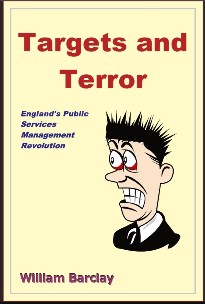
Read more in the book Targets and Terror by William Barclay. Available from Amazon: https://www.amazon.co.uk/Targets-Terror-Englands-Management-Revolution/dp/1916035388
Is the Customer Always Right?
‘The customer is always right’ is an oft-repeated maxim. But is it right? The idea has been around for a long time – it was popularised by American retail magnate Harry Gordon Selfridge in the early 1900s. Organisations do have to be keenly aware of the needs of their customers. But it is their consistent needs expressed as a group that are important. The attitudes, behaviours and propensity to complain or praise of individual customers are widely variable. Accepting a complaint that is clearly wrong or vexatious can have seriously negative consequences. Dealing with difficult customers can be a demanding and frustrating task for staff which consumes an undue amount of time. If managers side with this type of customer, relationships with staff are likely to be damaged. The retention of quality employees providing good customer service is a central success factor for organisations. Company culture plays a major role in keeping employees loyal and productive. Customer service is at its best when employees are empowered to deliver it with freedom and discretion. But this has also to include the power politely to explain why a complaint is not valid.
Of course customer feedback can be very valuable. There is truth in the belief that in the past some senior leaders in public services have been strangers to the need for feedback from service users.
Formal exercises for its collection need to be carefully designed if the results are to be meaningful and free of distortions from organisational politics. Questions need to be open and balanced. Responses need to be collected in an objective and accurate manner. Whilst the observation of repeated messages in customer feedback has the most pertinence, individual pieces of feedback can occasionally strike a chord and form a basis for improvement actions.
The development of a customer-focussed culture is often associated with transformation programmes in public services when organisations wish to adopt a more businesslike and commercial approach. The establishment of ‘customer-related’ job roles and feedback mechanisms may be part of these programmes. But the danger of ‘culture cranks’ needs to be avoided – individuals who believe that personal kudos is strongly associated with the promulgation of the new culture and who for example may be prepared to use any negative customer feedback, even when unjustified, to further their own agendas. It is the responsibility of leaders to develop a balanced culture in which excesses of zeal do not have negative consequences. Used appropriately, customer feedback can support and develop operational excellence, not detract from it.
When a complaint is valid, the response needs to be quick and meet or go beyond what the customer might expect. Some customer theorists have suggested that to have a complaint and deal with it well is more beneficial to an organisation than not having had the complaint in the first place. This is a risky belief but is deserving of some credit for the recognition that exceeding customer expectations can be of real value.
Read more in the book Targets and Terror by William Barclay. Availbale from Amazon: https://www.amazon.co.uk/Targets-Terror-Englands-Management-Revolution/dp/1916035388